
*Bourbon Culture is reader-supported. When you buy through links on our site, we may earn an affiliate commission.
| Don't like ads? | No ads |
The birth of a modern distillery typically starts with a brand launching a sourced whiskey while slowly building out a modest craft facility. But some distilleries buck this trend and jump in feet-first. Jackson Purchase took this more perilous and unconventional path to production by building a relatively large facility from the start. Located in Fulton County (on the very western edge of Kentucky), this massive facility represents a significant departure from the established distillery rows of Bardstown or Frankfort.
The site was originally conceptualized and built in 2008 by W. Ray Jamieson, a successful Memphis attorney who funded the state-of-the-art plant as an elaborate passion project. Yet, despite being outfitted with top of the line equipment, the distillery stalled before it ever truly began. For over a decade, a massive Vendome copper column still sat completely unused (kind of like the one Uncle Nearest has at their campus SICK BURN).

Ten years later in 2018, it had only managed to produce a mere 119 barrels before operations collapsed again. The facility was effectively left to become a Scooby-Doo Ghost Town after that. It wasn’t until a new ownership group took over a year later that the cobwebs and vagabonds were cleaned out to allow another go at it.
The Ghost Distillery Legacy
One oddity about the distilling industry seems to be that you must have a good backstory or a famous whiskey person to really get your product off the ground… and up until this point Jackson Purchase had neither. So the brand had to draw its historical weight from the 1818 “Jackson Purchase” treaty, firmly rooting its identity in the distinct geography of far-western Kentucky. Speaking of far-west Kentucky, there weren’t really any notable distilleries located on this side of the state that they could draw upon, making their story even more intriguing.
As I mentioned before, the distillery complex remained largely dormant until it was acquired by the current management group in October 2019. By 2021, it officially transitioned to Jackson Purchase Distillery LLC. Dispelling rumors of a fire-sale liquidation, the group secured the campus for an initial $8.76 million and subsequently poured a separate $10 million into a massive, state-of-the-art rickhouse expansion.

Rather than starting as a small-scale craft house, the equipment on hand is designed for high-volume efficiency. They specialize in contract-distilling for various brands, but I haven’t been able to identify which ones use barrels from them. At the same time, the bourbon they have been socking away for their own brand consists of a 70% corn, 20% rye and 10% malted barley recipe. It utilizes a sour mash process and it goes into Level 4 Char barrels (no toast) at 120 barrel entry proof. This all sounds fairly standard, but Jackson Purchase does have one trick up their sleeve tha makes them different…
Beam influence and the Art of the “Wet Charge”
The brains behind the operation at Jackson Purchase is spearheaded by two big names in the industry: Craig Beam and Terry Ballard. Craig Beam serves as the Master Distiller and brings his last name legacy (seventh-generation Beam) to the production floor. He had 32 years of experience at Heaven Hill, including a tenure as Co-Master Distiller alongside his father, his involvement provides immense technical credibility. Just a quick aside here, but isn’t it interesting how Heaven Hill has basically shunned any mention of him since he left? The bad blood between the two could probably fill a book.

Anyway, working alongside him is Terry Ballard who holds the dual roles of Assistant Master Distiller and Director of Plant Operations. Ballard previously spent over a decade as the Lead Distiller at Willett and his transition to Jackson Purchase brings a focus on the nuances of traditional distilling equipment.
One of the most technically distinct aspects of Jackson Purchase’s production is a technique Craig Beam brought with him that sees a technique called “wet charging the doubler.” If you’re unfamiliar with what a doubler does in the distillation process, let me explain. A doubler is a secondary kind of “pot still” that sits between the primary column still and the final condenser. In most modern large-scale distilleries like Buffalo Trace or Maker’s Mark, the doubler is used to refine the “low wines” coming off the main column. Most operations run their doublers “dry” to maximize throughput and efficiency.
In contrast, wet charging involves pre-filling the doubler with a starter liquid, such as water or tails from a previous run, before the day’s distillation begins. This pre-filling ensures that the first vapors entering the chamber are immediately submerged in a liquid buffer. The primary benefit is improved sulfur scrubbing. Sulfur is a naturally occurring byproduct of fermentation that can impart harsh, unpleasant or rubbery notes to a young spirit. By forcing the vapors through the liquid in a copper chamber, a chemical reaction occurs where the copper “strips” even more sulfur out of the distillate. The end result is a cleaner “new make” distillate and copper sulfate which doesn’t make it to the final High Wine condenser. While other historic brands like Wild Turkey are known for similar traditional distilling philosophies, the specific emphasis on the wet charge is a point of distinction for Craig Beam and Jackson Purchase.
The Mississippi River Valley Environment
The geographical location of the distillery in the Mississippi River Valley introduces a specific set of environmental factors that we often gets overlooked in whiskeymaking. These include access to calcium-rich water of the Mississippi Embayment Aquifer and a climate that mimics Bardstown or Louisville but that runs about 4-5 degrees higher. This temperature difference means that Jackson Purchase whiskey matures at an accelerated rate – but not totally at the extremes like further south might do. The argument is that the extended summer season in Western Kentucky keeps the whiskey actively maturing in the wood for a longer period each year, facilitating more frequent, aggressive thermal cycles.
I would be remiss if I didn’t point out the technical differences between extraction and maturation. Heat is a catalyst for extraction, which pulls color, wood sugars and tannins from the oak. This can make a young whiskey appear and taste more mature by providing a more tannic experience – like it’s been in a barrel for longer. Maturation is a more complex chemical process involving oxidation and esterification. This is where harsh alcohols slowly transform (or disappear) into the delicate fruit and floral esters found in older spirits. True maturation is a function of time that temperature alone cannot fully replicate.
While higher heat leads to more aggressive extraction and a higher “Angel’s Share” due to evaporation, it can also lead to a more tannic profile if the tasting team is not fully on top of it. The high evaporation rate concentrates the spirit and can raise the proof significantly, but it risks pushing the wood influence to a point where it dominates all other notes. The claim that a four-year product can directly rival the profile of a ten-year-old whiskey is a bold one – and one I’ve seen before *coughdistilleriesbasedoutWestcough* – that depends entirely on whether the increased extraction has been balanced by the clean distillate produced by the wet charging process.
Okay, now that I’ve wrote a book, are you ready to hear about how this bourbon tastes? I know I am. Let’s get into it. I sampled this neat in a glencairn.
Tasting Notes
Nose: The nose is unfortunately full of young, grainy notes right off the bat. There is a hit of ethanol almost every time my nose gets close to the glass. There are some fruit scents here like cherry cordials and maybe some Calvados. Calvados is a better scent to get than green apple because the latter is unpleasant in high amounts. So maybe this demonstrates the distillate is a bit more refined than your typical 4-year-old bourbon. Getting back on track, I find a telltale Jim Beam “nutty” note which is funny because… did Craig bring some of that classic Beam yeast with him when he arrived at Jackson Purchase? Finally, there is a bit of baking spice notes that revolve around cinnamon and pepper.
Palate: The mouthfeel is somewhat viscous which tamps down on any kind of harshness that I was bracing for. However, a viscous mouthfeel can’t hide more grainy notes from exposing themselves. The flavors are overall bright with cinnamon pops, herbal notes (Riccola Cough Drops, anise and squash blossoms) with some youthful notes like sourdough bread and a bit of astringent oak. A bit of caramel sweetness tries to keep everything balanced, but there’s no getting around its youthfulness. Finally, fruit notes include raisins, cherries and melons. The nuttiness I found on the nose is barely noticeable on the tongue.
Finish: The back end doesn’t stray too far from the palate and is dominated by ground black pepper, cinnamon and a herbaceous mint. As the spicy heat slowly fades down the chest, the finish settles into earthy, grainy (graham crackers) and a bit of honey sweetness. A touch of bitter chocolate rests on my tongue along with woody oak and a hint of orchard fruit.
Score: 5.8/10
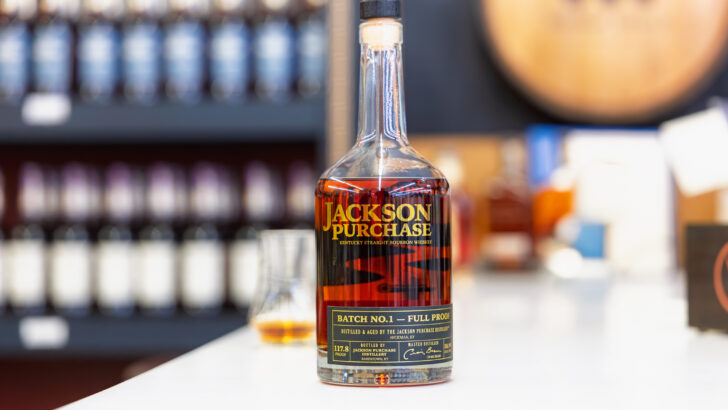
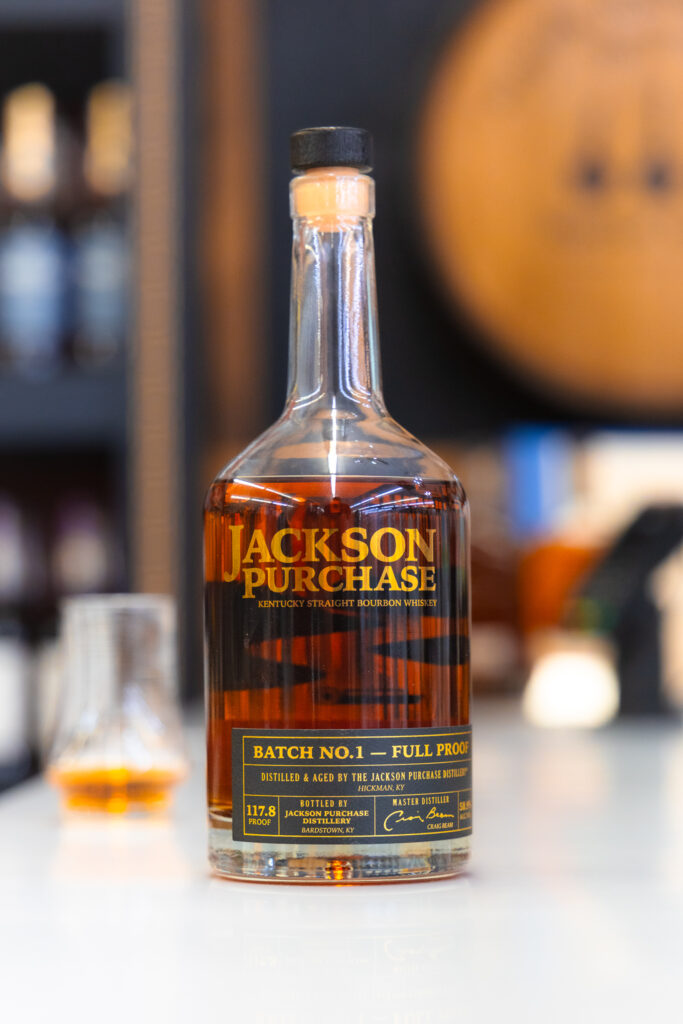
After trying this one, it’s clear this isn’t a completely finished product. It seems like its on the right path, but isn’t fully there yet. If the wet charge process really does take out the excess sulphur (which isn’t something I pick up on in most column-distilled whiskey anyway), then it still doesn’t take care of the youthful graininess that I find here. Also, the ethanol really highlights the proof in every sip – and not in a good way. I’ll believe Jackson Purchase is good once they get their 117 proof bourbon to taste more like a 105-110 proof bourbon.
Despite the book I wrote up above, this 4-year-old bourbon doesn’t taste any older than the age statement suggests. I am sure that in a few more years, this could be a very nice product, but it likely suffers from being the product of the first phase of production. I’m sure Craig and Terry are actively assessing the whiskey they produced back in 2021/2022 and are making changes that will really dial in the product and make it better.
Final Thoughts
At an MSRP of $59, I think the producer has tried to cushion the risk that many buyers face when they see a new whiskey they want to try, but don’t want to throw away their money outright. The $50-60 range is just enough for the curious to take a stab at it. I don’t think that I would recommend you buy a bottle first – more like try it at a bar and see how you like it. But if you do, then I’m sure that it will only get better from here. I wish the team the best and hope that they keep trying because this distillery has a cool backstory and is trying new things to create a better product. But they haven’t quite nailed it yet, so save your money for a couple more years before trying it again.
Joe C.
Sunday 12th of April 2026
Finally, a review that aligns with my own experience.
Tried this at KBF last year amongst a lot of buzz. Was very underwhelmed. Tasted grainy/crafty. Hard pass for me.
Later I see/hear all these reviewers talking it up like it is something fantastic. Was beginning to think my average palate was worse than I thought.
Thanks for the honest review!
Kevin M.
Saturday 4th of April 2026
Decent review, but I'm a little surprised you weren't a bigger fan. It seems that I definitely liked this one a little more than you did and found it to be a pretty valiant first effort.
It's certainly young (I guessed less than 5 years old) with some typical grain forward and "crafty" notes, but I also found it to be rich and full bodied with lots of complexity and depth for its age. It has fantastic dark and bold flavors, with a really nice creaminess that coats the palate and a nice finish that is far from unpleasant. As it sits in the bottle right now, I found it to be a rather enjoyable pour...but I can also see a ton of future potential. If the profile and flavors continue to develop on the path they seem to be on, I really think this could be one of the best whiskeys on the market in a few years.
I have a shelf in my lounge that is full of really disappointing 4-6 year old whiskeys, as I'm sure you probably do as well, but for me...this isn't one of them.
Cheers!