

| Don't like ads? | No ads |
I covered the rundown of how Circle City Whiskey Company got its start in a previous review for this website. So I won’t go too much into the weeds again, but what you need to know is that their story started as a local secondary market group who then “went legitimate” by rebranding as a single barrel club. They piggybacked off of local retailers in the Indianapolis area until coming to the realization that the easier route might be to buy their own barrels outright. The only issue was distilleries and brokers don’t just sell barrels to anyone with the cash, you have to be properly licensed.
A group of guys in the club decided to take the leap to becoming a Non-Distiller Producer. Suddenly, they had access to way more barrels from almost every distillery. Doing it this way eliminated the compromises that come with working through liquor distributors to obtain desirable barrels picks. That’s more or less the story of how Circle City came to be.

In the beginning, Circle City was buying barrels primarily from MGP and another “undisclosed” Kentucky distillery with the bourbon mash bill of 78/10/12. I normally spell these things out, but I promised Drew Black (the face of Circle City Whiskey Co) I wouldn’t so as not to violate his NDAs – but it shouldn’t be that hard to figure out.
All of this was pretty standard until last year when Drew messaged me with a surprise: he managed to secure a 4 barrel batch of Kentucky bourbon with the mash bill “75/13/12.” Normally, Jim Beam (who is also known to use a mash bill similar to this) would have been my first guess, but when I asked Drew if it might be from that “other distillery,” all he could do is give me a wink of his eye and a twist of his head. I was shocked.
To back up everything he told me, he also provided a picture of the barrel heads. I gobbled with glee. Unfortunately for him, one of the four barrels was empty upon receipt. Thankfully the broker comped them an extra barrel when he placed another order.
“Mystery” 75/13/12 Mash Bill
I’m not sure how these barrels escaped that “mystery distillery’s” grasp, but I have to wonder if their low proof had something to do with it. It might have been too low to use in its intended product or perhaps the profile was off. Whatever the case was, none of the barrels that arrived at Circle City were over 105 proof. This meant they lost more than 10 points over the 8+ years they were aging.
I asked Drew which warehouse these barrels came from and he said the broker told him “G.” Warehouse G is one of the 10 original warehouses constructed on Tyrone…errr, that “mystery Kentucky Distillery’s” campus. Oh darn. did I give away the distillery?


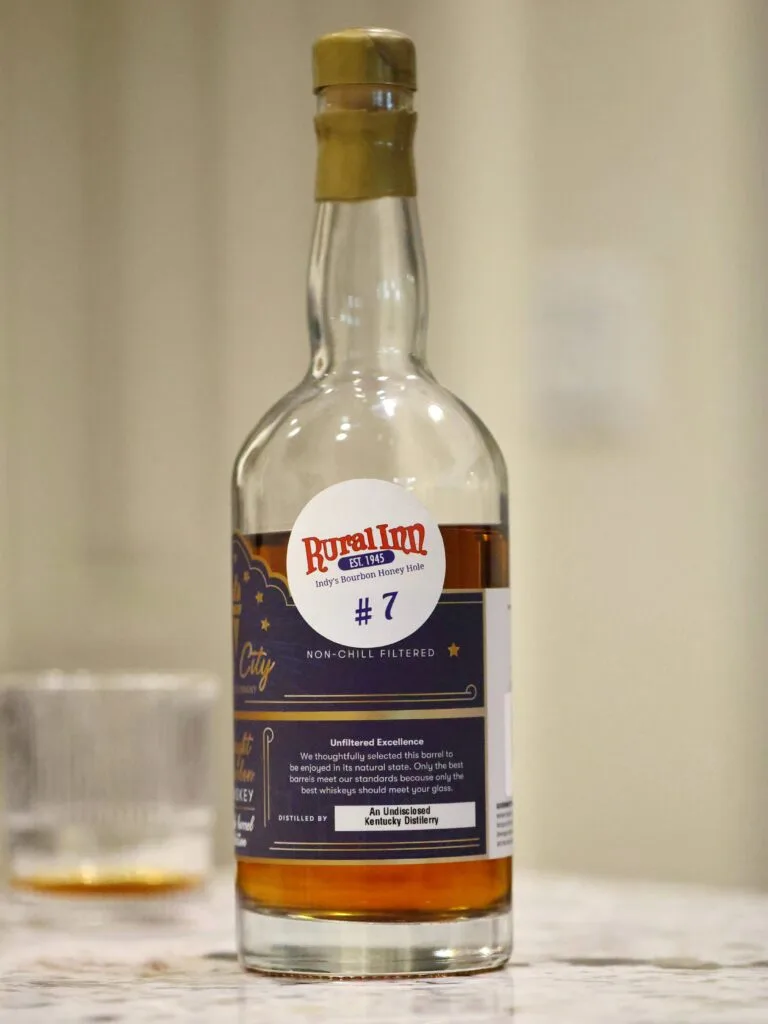
The bottle I’m reviewing today was a single barrel picked by the one and only Rural Inn out of Indianapolis. Ray (Rural’s owner) has been a friend and supporter of Drew for many years now, so it felt right that he got the first pick for one of these barrels. The stats are 103.2 proof (cask strength, non-chill filtered) and 8 3/4 years old.
The price I paid for my bottle was around $85 which comes out to about $10 per year aged. But if you view it in the context that it’s also technically bottled at cask strength, then the value seems even better. So how is it? Let’s find out. I sampled this neat in a glencairn.
Tasting Notes
Nose: A fairly strong sensation of caramel, salted nuts, nougat and vanilla cream. These dessert-like vibes are going to be a consistent theme throughout, so get used to it! I also find a nice amount of spice like cinnamon spice cake, clove and nutmeg. Fruit scents are few and far between, but I think I’m picking up on a candied orange peel as the session goes on. The tannins are quite rounded and upfront despite being under 9 years old. I can easily pick out some char and seasoned oak notes. The whole dram is easy to nose because of the lower proof, but overall it’s still quite rich.
Palate: For the proof, this has a nice kick of spice on the tongue as well as a thick mouthfeel. The one trait that’s standing out the most for me is the spice. It kicks like it’s 10 proof points higher – not a bad trait to have in my opinion. The typical dessert traits are in action again with more caramel, vanilla and nuts but this time I’m finding a small trace of chocolate. Fruit notes are backed again by some candied citrus peel and it’s joined by some spiced pear. The oak on the palate is decent, but it was better when I smelled it. It still has a touch of bitterness but not enough to ruin the experience.
Finish: Caramel, semi-sweet chocolate and nougat round out the finish as the tannins and spice slowly fade to the back. I didn’t expect to find a lot of complexity on the finish, so I’m not bummed. I am happy that the slight bitter oak taste on the palate did not make itself known on the finish.
Score: 7.3/10
I enjoyed my time with this bottle and have had a chance to share it among many of my friends. Most agree that it’s a crushable bourbon that can be enjoyed over long sessions due to the low proof. Most noted the similarities between it and bottles they’ve had from the distillery it originated from (once again, IYKYK). Most importantly, everyone agreed that the fact they were able to try cask strength bourbon from this distillery at this low proof point and age made it unique enough to seek out. It’s not every day something like this pops up.


Final Thoughts
Lately we’ve seen a handful of producers release similar bourbons containing a mystery 75/13/12 mash bill. I know many people want to compare those bottles against each other to see which is better, but I think the more interesting thing to do is try to round up as many as you can and taste the full spectrum of flavors that different ages and proofs give you.
As for future Circle City releases, I hope they continue to bring us whiskey that the normal consumer typically doesn’t have access to. The rich tapestry it weaves when we explore bottles like this keep the hobby interesting and always give you something to talk about during the next get-together with friends.
A word about the pictures for this review
I don’t usually include a section like this, but I wanted to take a moment and nerd out about the lens I used to take the main pictures in this review. If you know a little bit about photography, you already understand what “bokeh” is – the blurred background that shows up whenever you focus on an object that’s close while the background is far away. Sometimes you’ll see reflections of light that create small, blurry dots of light. If you look closely at the cover picture, you’ll notice that the bokeh in the background has dozens of tiny rings. This was not photoshopped in, it’s how it looked through my viewfinder.
Photographers call this “donut bokeh” due to the distinctive pattern this lens makes. What lens is it? A Maksutov f/10 1000mm mirror lens that was made in Soviet Union back in the 70’s (a more common f/8 500mm version is widely available on eBay). If you look at it head-on, you’ll notice a small circular mirror in the center. I could get into specifics on what this does and how it is used to magnify incredible focal lengths in a relatively compact size, but I’ll let Wikipedia do it for me.


A friend and coworker of mine just so happened to have this lens with a Canon adapter and let me borrow it for a weekend. My camera is a R5 Mark II and I’m used to having all sorts of features like autofocus, Image Stabilization and easy-to-focus rings. None of that worked with this lens. I had to manually set the focus, aperture, find the right ISO, tinker with the shutter speed and switch to a 10 second timer to ensure there were no wobbles after I pressed the shutter button.
Setting the picture up was a comically long process of walking about 30 yards back and forth to make tiny adjustments to my table so I could have it centered on the exact background and foreground spot I wanted in the frame. I positioned the table and bottle on the sidewalk in front of my house. The flowers you see in the background are about 15 yards behind it. Then I walked across the street into my neighbor’s backyard and set up my camera with a tripod that wasn’t really meant for this (I was using it as a monopod earlier that day for baseball). Finding the right angle and focus took about 30 minutes.


In the end, I found a spot that was good enough and got my picture about as clear as possible. Using a Snapspeed App, I did some quick editing for contrast, sharpness, ambience and a bit of saturation. This was my final result. I know it’s not totally in focus and lacking in true depth, but it’s acceptable for now. Once I learn Photoshop, I’m sure I could get a much better result.
I don’t recommend this lens for product photography – save it for shooting the moon at night or spying on your neighbors so you can report them to the KGB. But the donut bokeh is a fun change of pace in a bourbon review like this and I hope you enjoyed hearing about it.