


| Don't like ads? | No ads |
I’ve always thought that Old Grand-Dad Bottled in Bond was one of the best sub-$30 bottled-in-bond bourbons on the market. It simply had more flavor than anything else that Beam, Heaven Hill or Barton put out. I attribute it mostly to the high-rye (63/27/10) mash bill, but the way it’s made gives it that extra edge.
What about the way it’s made is different? For starters, Beam supposedly uses a lower “still proof” than they use for Knob Creek or Jim products. It’s not made public, but I’ve seen some sources throughout the years talk about how the still proof for Old Grand-Dad and Basil Hayden’s is around 127 and the barrel entry proof is around 120 (but maybe as low as 115). To some, the increased water content might not seem like a good thing. In reality, the lower alcohol content will allow different wood sugars to dissolve compared to wood sugars that dissolve at 125 proof – which is the barrel entry proof of all the Booker’s/Knob/Beam products.


There’s also the small matter of a different yeast being used. Everyone knows that Beam’s yeast (which they use in just about every product of theirs) has a mild nuttiness to it, but people might not know that Old Grand-Dad its own unique yeast. Back in the days when National Distillers owned the OGD brand, their own proprietary yeast was used. To those who have had it, it seemed to impart this sort of fruity/butterscotch characteristic to it. When Beam bought National Distiller’s, their goal was to keep the yeast, mash bill and most of the distilling specs as close as possible to the original. But over the years enthusiasts have noticed modern OGD tastes more nutty – almost like it’s using Beam’s yeast.
The story of Old Grand-Dad Yeast
I have a short story to share regarding that yeast. In an interview I had with a former ND employee, he told me that they propagated their own yeast at the OGD Distillery in Frankfort. Next to the yeast room was a large freezer that was used to store yeast for later use or to test for mutations. That freezer had to be kept below a certain temperature or the yeast inside could begin to multiply without the proper supervision and possibly mutate.
Since the OGD plant was only distilling every other year in the 1980’s, that meant that workers weren’t around to record if the freezer was always operational. So they had an electrical line hooked up to a thermometer inside of the freezer and ran it all the way out to the guard shack at the front gate. If cooling was ever interrupted to the freezer and the temperature began to rise, a warning light would come on in the guard shack. That was their cue to call maintenance and have someone come out to fix it immediately.

After Beam bought the distillery, they replaced most of the workers with their own – this included the guards. Some time after the plant was sold, an employee that was retained from National Distillers noticed the light was on in the guard shack. He asked the guards if they called maintenance. The guards said they didn’t know that’s what the light meant and also it had been on for a while. A call was made and a short time later, some Beam employees came to fetch all of the yeast in the freezer to take back to Clermont.
What happened to the yeast? Did it survive the trip? Did it end up mutating? Or has it gradually been exposed to Beam’s yeast and somehow cross contaminated? Is that a thing? My guess is that something did happen to it because it is a wholly different product from the OGD of yesteryear.
Getting back on track to this review, Beam has recently taken an interest in reviving all of the brands it retained from National Distillers to include Old Overholt, Old Crow and Old Grand-Dad. They have started to include improved age statements, change packaging and even – in the case of Old Overholt – instituted a change in the rye whiskey recipe to reflect a more traditional Pennsylvania style.
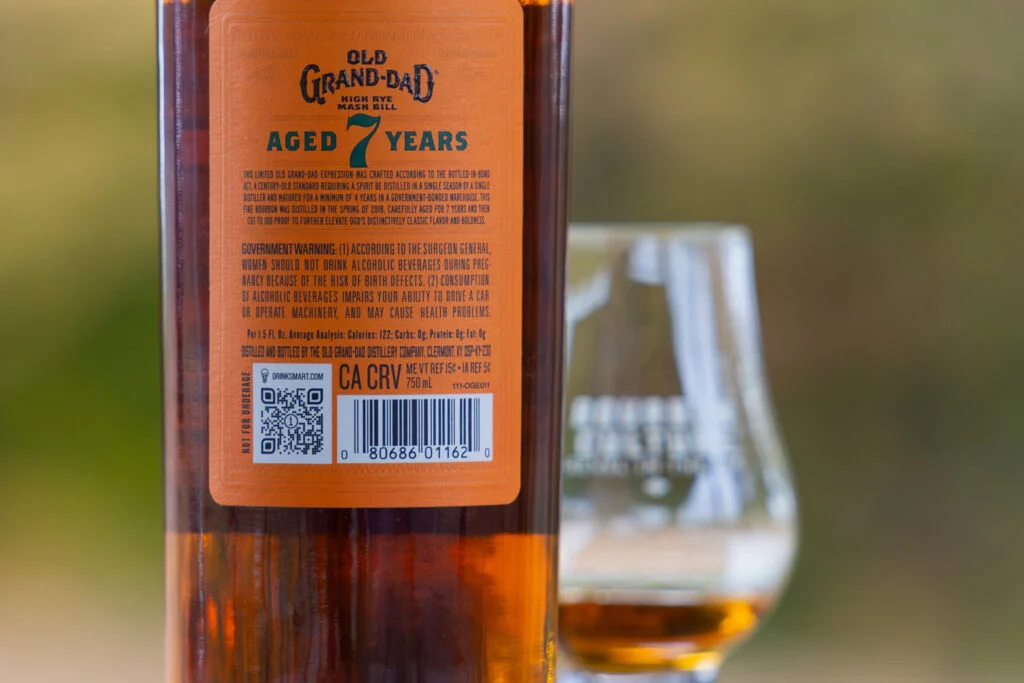
The bottle you see before you is one such project of theirs which puts an actual age statement on Old Grand-Dad BiB. The previous version was never age stated, but I had a feeling it was between 5 and 7-years old depending on the batch. As I mentioned above, I thought it was the best of the affordable BiBs. Now that it wears a 7-year age statement and has a higher price tag ($45 give or take), does it have more to offer from the previous version? Or is this just a cash grab? Let’s find out. I sampled this neat in a glencairn.
Tasting Notes
Nose: There is a sort of higher-rye element to the nose with all of these herbal notes I’m picking up. I don’t find oak per say, but I am finding a light cedar note that gives a woody vibe. I also find a good amount of citrus and a sort of buttery caramel scent that doesn’t quite match up to the butterscotch notes of yore, but seems like it’s getting close. The whole nose can be summed up best by saying it’s just sweet enough while also having plenty of rye traits to keep you on your toes.
Palate: Caramel sweetness starts off the flavors I find on the first sip followed in quick succession with baking spices like nutmeg, clove, cinnamon and peppercorns. There’s an herbal sensation on my tongue coupled with some cherry licorice, orange zest and apricot marmalade. Once again, I’m not finding much in the way of oak, but it doesn’t taste young. Nuttiness starts to set in the longer the session goes on, but it’s not as powerful as a traditional Beam product.
Finish: Lingering spices like cinnamon, nutmeg and peppercorn followed by caramel apple, citrus and unsweetened stone fruit. The finish is balanced and has a good array of flavors that hang around in your mouth. I’m pretty darn happy with it.
Score: 6.6/10
You’ll have to take my word on it, but this is the true score I gave it right after I was done tasting it. It was only a day afterwards that I looked back to my review of the standard OGD BiB from years ago to see if I was in line with that score. It was funny to find rated the older one only a tenth of a point less than I did here. So the good news is that I still thought highly of OGD BiB but the bad news is I must not have thought it was so much better than the non-age stated version. Do with that information what you will.


Still, for all the talk on value, I will say that this is a very pleasant bourbon that I think should be in more restaurants, bars and home bars. It’s got a familiarity to it that does hint to Beam while also delivering a nice assortment of fruit and spice. It’s also not as corn-forward and sweet as its sibling bottles are either – always a plus in my book.
Final Thoughts
I still find an enjoyableness from this mash bill and will look forward to any new release under the Old Grand-Dad name. But I am slightly concerned when a new, more expensive product comes out that overlaps with the cheaper version. It’s a warning sign that the older, cheaper version is going to get axed to make way for the higher priced version. Just look at what happened to Heaven Hill BiB (6-year vs 7-year). It usually means the old version is on its way out and the new version is staying put with the hopes to make more money.
Connor
Thursday 6th of November 2025
I love the OGD BIB standard. One of my favorite bottles. Will have to try to find this age stated one.
John D. Alder
Wednesday 5th of November 2025
I remember Old Grand Dad flavored pipe tobacco. Bourbon goes well in eggnog !