

| Don't like ads? | No ads |
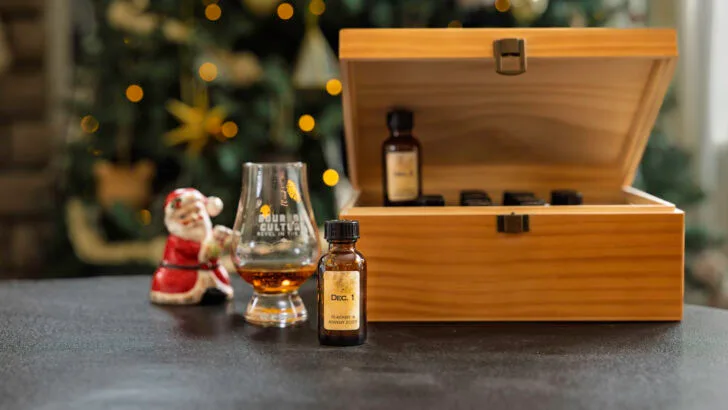
I know that many of my readers are currently in the middle of participating in a Bourbon Advent Calendar while I’m sure other readers have never heard of this concept before. Whichever camp you fall into, this article will cover the ins-and-outs of how a proper Advent Calendar should be ran so that it guarantees a fair and fun time by everyone in your group. There’s also a degree of low-stakes competitiveness that ramps up the fun even more. So read on! Even if you’re an old hat at this kind of stuff, maybe you’ll pick up a thing or two throughout that you can apply next December.
The Framework of a successful Advent Calendar
I wish I was smart enough to have come up with all the rules for running an Advent Calendar. Thankfully I fell into the right group who has polished and refined the way they run their Calendar every year since 2020. They call themselves the Slackers (because the group uses the Slack app to communicate) and are based primarily out of the Bay area in California. Many of the members are also a part of the Neat Drinker’s Association (I kind of use the two names interchangeably).
- Doing it together at the same time fosters bonding and good conversation
- Having a common scoring system enables the group to see which bottles were most and least popular
- Having a minimum bottle value ensures that nobody feels like they were taken advantage of while others “cheaped out.”
- Having a spouse/SO help in verifying that there aren’t duplicates submitted will help keep the main organizer in the dark as much as possible so they can be a participant.
1. Get commitments from your people
Each year in October, a discussion takes place to identify who wants to participate in the Advent. This isn’t exactly a light conversation because you’re looking for participants who will follow through with a commitment. The goal is to have members who have too many commitments to bow out of the event if they’re going to be gone most nights. It sucks, but it’s more fair to the group that way.
The event theoretically is capped at 24 members (one for each day) but in reality we know that not everyone can drink on every day. So the group usually tries to keep the number around 16-18 participants which usually allows for two days off per week. We have found that Friday and Saturday nights are typically the busiest night during the holidays, so we schedule them as our off-days. Another way of looking at it is Quality vs Quantity. We’ve found it’s much more enjoyable when everyone can finish the calendar and feel good about the pace and pours rather than trying to swamp everyone with more booze than they’re already consuming.
2. Pick a leader to run the Advent
For our group, the leader has changed three times over the last 6 years. It’s a demanding role that is mostly thankless (but more on how to show appreciation in a bit). The Advent leader needs to be dependable and be good with multitasking. It also helps if they are the generous type because I’m guessing there are some things that require some out-of-pocket expenses (like labels) – not to mention their time.
3. Pick a method of communication
This may sound like a no-brainer, but you should have a method of communication that all of your group can use at the same time. For our group, we use the Slack app. This has a similar feel to the Discord App (which also works well). I’m sure other Apps are just as capable like WhatsApp, Signal and Telegram. Maybe a group text could work if you have a very small group, but it seems like that would be the least efficient method.
The part I find is the most beneficial to using Slack is that when it comes time to guess what bottle it is, you can make a post (we have agreed on just posting a picture of the sample bottle and our surroundings) and then make a comment to that post so it that isn’t visible unless you tap on the “expand” icon to read it. This keeps the chat less messy and prevents members from seeing the other guesses until its time for the reveal. Of course you could cheat and read what everyone said to guide you towards a guess, but that takes the fun out of it.
The bottom line is it’s more fun when you can all schedule a time to interact and talk about the whiskey for that day. I personally get a rush every night knowing that we’re all going to talk about the same thing and banter about what tasting notes we get and what our guesses are. It’s a lot of fun!
4. Bottle Selection
For the Slackers, it was decided early on that all bottles would have a minimum value of $250. That could be either retail value or (verified) secondary market value. This eliminates the feeling of unfairness that I’ve heard about in other groups where one participant submits a $30 bottle of Knob Creek while another guy submits a $400 bottle of dusty Wild Turkey.
If you’re saying to yourself “$250 is too rich for my blood,” then consider the following: You know you’re going to be receiving more than a dozen samples of equally priced bottles. The chances that you’ve tried most of those are far less likely than if you receive a dozen+ samples of, say, $100 bottles (Midwinter Nights Dram again? Ugh!). Try to set a high enough minimum that it doesn’t price people out, but it will guarantee good bottles are entered. And if there are stark price point differences between members, maybe just have two separate Advents that year.
As I mentioned above, somebody outside of the group should be called in to verify that nobody is submitting a duplicate bottle. For us, the person who was running the Advent Calendar was Craig. His wife was generous enough to do the vetting and reveals – that way Craig could also participate without knowing what bottles were entered.
For this year, we all started submitting our bottle ideas to Craig’s wife at the end of October. It was our job to ensure we were abiding by the $250 minimum rule and it was her job to ensure we weren’t submitting duplicates of bottles. In the past, we’ve allowed different releases of Old Forester Birthday Bourbon or Old Fitzgerald Bottled in Bond Decanters to be submitted. As long as it was a release that was slightly different each year. Craig’s wife replies back with a “Go” or “No Go” to verify our pick.
5. Sample Bottle Consolidation
Once everyone has their bottle verified, next comes the sample pouring. Craig sends out a link to buy 1oz AMBER sample bottles (usually from Amazon). We have all agreed on amber ones because it disguises the color until the moment you pour them and also having matchin colors ensures nobody can identify their own sample. It’s not a requirement to buy from the link he sends, but it helps. Also, using new sample bottles ensures that no cross contamination occurs from whiskey that might not have been rinsed out all the way before.
Craig sends his address out to the group along with a “due date” to have them sent in. Realistically everyone should send theirs in no later than the weekend before Thanksgiving. This gives the Advent leader time to sort and re-package everything to get them delivered before December 1st.
When the group leader receives a box of samples (which members are encouraged to send in the original boxes they came in), they will be assigned a number. This number is usually based on the corresponding calendar day it will be used. Craig labels the top of the bottle cap and the sides with that date and number for all of the sample bottles. Then he records the person and the date date he assigned to which person’s bottles. If everything goes well, he still doesn’t know what whiskey is inside the bottles at this point. I’ll tell you how that’s revealed in a little bit.
6. Everyone gets their Advent boxes
Obviously, every time a box containing bottles of liquid gets shipped, there is going to be a risk it gets lost, confiscated or something breaks along the way. So the less opportunities that these bottles are shipped, the better. Always remember risk is something everyone agrees to before it begins.
Craig has to ship bottles to some members, but for others, there is a system of handoffs made around the Bay Area where everyone helps out to pickup and deliver boxes as much as possible. At this point, you can see where there’s a degree of trust that goes into the group where he’ll front the money for shipping, but it’s up to us to pay him back.
7. Optional Goodies
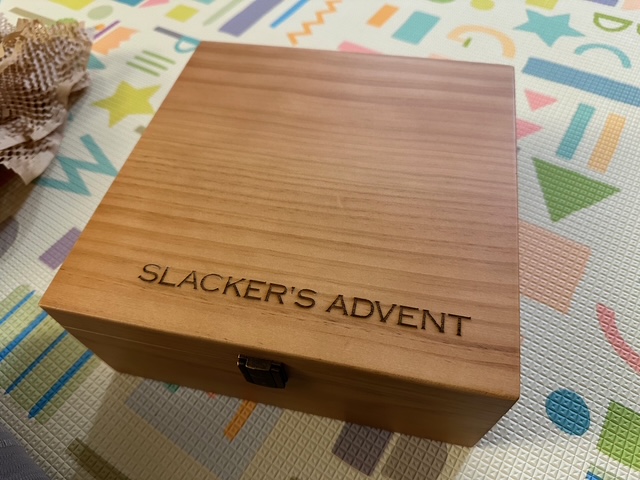
Craig stepped up the Advent with an extra bit of flare last year when he had custom sample boxes created with the group name etched in and two dozen bonus bottles with various aromatics included inside. Him and his wife painstakingly crafted various spices, sweets, chocolates and syrups into 1oz sample bottles. He did it to encourage a more uniform assessment of tasting notes when it came time to guess what they were tasting.

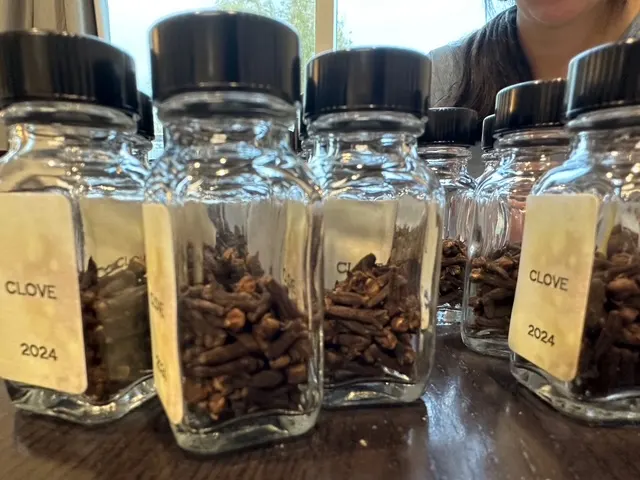

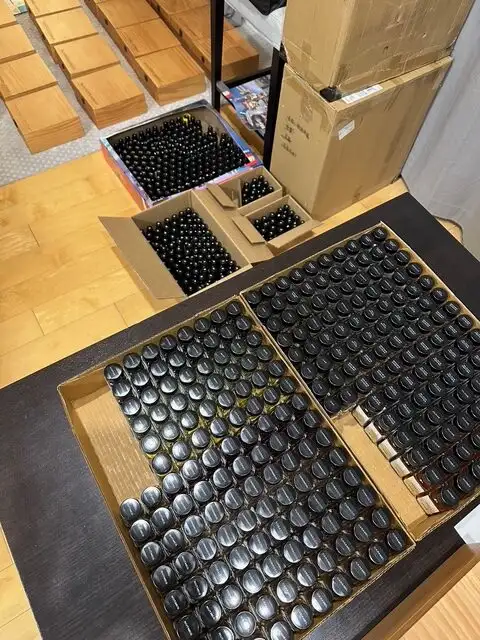

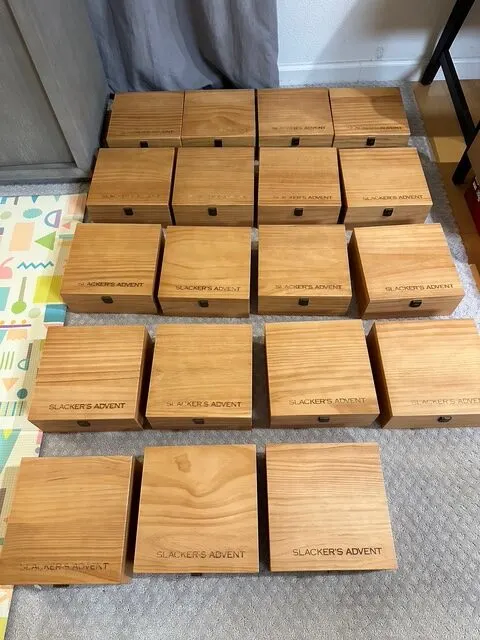
These really added a special feeling to the Advent calendar last year and many of us continue to use the boxes and some of the spice bottles to this day.
8. The Advent Calendar Begins
Since the group is spread across four different time zones, a “reveal” time is set that allows East Coast members to not have to stay up so late to hear the reveal while also allowing plenty of time for West Coast members to come home from their jobs and do the family thing before pouring a drink. In the past, we had done 9pm PST (which was midnight on the East Coast) but this year we’ve bumped it up to 8pm PST.
One thing we found works well is to have each member submit their tasting notes, score and a guess as to what the bottle is by first posting a picture of their sample that night (in the background, we all usually put something attention grabbing just for fun) and then we reply to that comment. That way, the only way you can see it is by tapping on the “replies” icon underneath it.

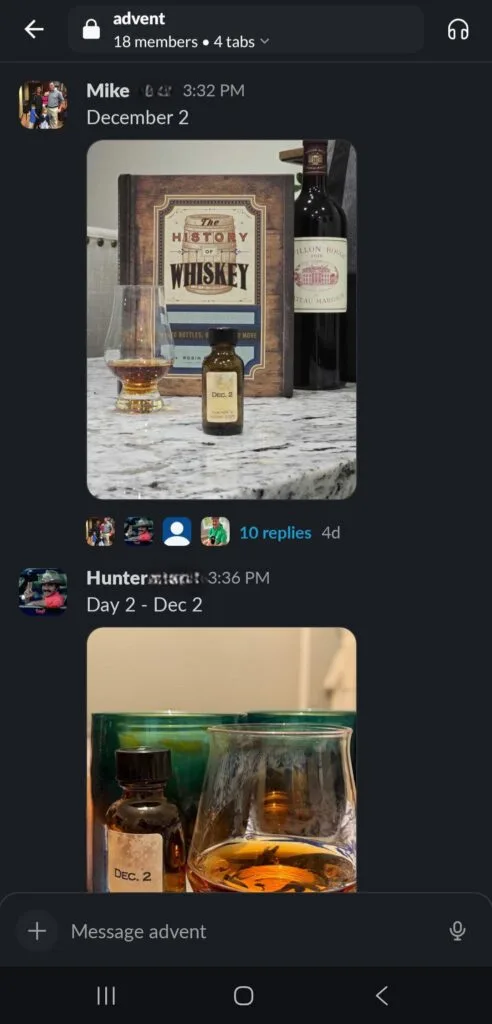
The gentleman’s agreement we have in place is that you shouldn’t look at what other people have guessed until you have submitted your own guess. For tasting notes, everyone can be as detailed as they want to be. Even guessing what the bottle is isn’t as structured as you’d think. Sometimes you just don’t know what it is, but you can enter a guess on the proof or age. But what we really want to know is what score you give it. This is because we keep a spreadsheet that gives us good feedback on which bottles were the winners and losers and also shows trends on how a particular person rated. The group is usually pretty split when it comes to people that typically give very high scores or very low scores (or those in the middle).
If you can’t agree on a scoring system (we use the 10 point scale, although most wine enthusiasts are more familiar with the 100 point scale), it shouldn’t matter. Just agree that you’ll always convert them the same way. A good rule of thumb is if they’re using a 100 point scale, just just put a decimal in the middle so a 94/100 would be a 9.4. Similarly, if only one person is using a 10 point scale, just multiply by 10 so a 7.8/10 would be 78. As long as they are consistently doing it this way, the overall average of the bottles will be equally known.
9. What to do if you can’t submit a guess for that day
While the system I’ve laid out here might seem a little overwhelming, we know that life sometimes gets in the way. This past week, three members are traveling far away from their homes. They have the option of pre-sampling their bottles and recording their results ahead of time or posting them later on. Some will even take their samples with them and flesh out the notes during their downtime. We all understand how it goes. The most important thing is if you’re going to be absent on the day of the reveal, get caught back up as soon as you can and remember to enter your scores on the spreadsheet when you do!
10. A little competition never hurt anyone
The last thing I’ll talk about is how to introduce a little competitiveness into the Advent Calendar. For our group, we have two things you can “win.” The first one is “Best Guess” which is tabulated each day by whoever came closest to guessing the bottle. Sometimes nobody did and we just leave it blank. Sometimes there are more than one person who guess the same thing and get it right. There is no standardized way to grade who has the best guess if nobody gets it right, but we use the “round of applause” scale where basically the contenders argue and whoever is the loudest wins.
But the main prize for our group is who submitted the highest ranked bottle that year. This is why entering your scores daily is so important. For our group, we actually have a prize you can win for having the top bottle – it’s a custom etched decanter filled with an ounce of every bottle that was submitted that year for the Advent. Granted, that’s an extra cost that we all agree is divided up among members and it’s an extra ounce out of all of our bottles that we submit, but at this point, what’s a little extra money?


The main point I want to drive home about creating some sort of prize for “winning” the Advent is that it encourages members to submit the best bottles that they can to try and win. Anyone can go to the store and buy a boring $250 bottle of Whistlepig 15 or Olde St. Nick, but those are boring. If you want to win or earn the respect of your group, you need to bring your A game.
11. Keep it exciting and have fun!
The most important rule of all is to have fun with the Advent Calendar. Banter is strongly encouraged, so be sure to leave a comment with your buddies on what you disagree on or commonalities with your notes. Brag a little and congratulate a lot. Don’t forget to be thankful towards the person who submitted the bottle for that day because whether you liked it or not, it meant something to them and they wanted to share it with the group. Just don’t submit a bottle of 2022 Old Forester Birthday Bourbon and everyone wins.
HUNTER WALK
Sunday 7th of December 2025
Thanks for writing this up Mike. As one of the Slackers, this is my favorite event we do each year.