


| Don't like ads? | No ads |
These next reviews kind of blend into each other as I attempt to sample my way through different generations of Wild Turkey’s 12-year-old (Beyond Duplication) bottlings, so make sure to check them out here for to understand the complete background for this storied lineup.
I previously mentioned by the early 1980’s whiskey producers in the US watching their sales decline at the same rate that their maturation warehouses were filling up. This time period was known as “The Glut” and has come to be revered by modern-day enthusiasts for the many excellent, ultra-matured bourbon and rye whiskey that was sold back then. It was not uncommon for producers to blend in barrels that were twice as old as the age statement listed on the label.
Wild Turkey’s approach to the Glut was to create a new product line with an older age statement on the label while also hoping to charge more money. In this way, they wouldn’t be letting their most valuable barrels (i.e. the oldest ones) go to waste by dumping them into the same vats as their standard 8/101 bourbon.


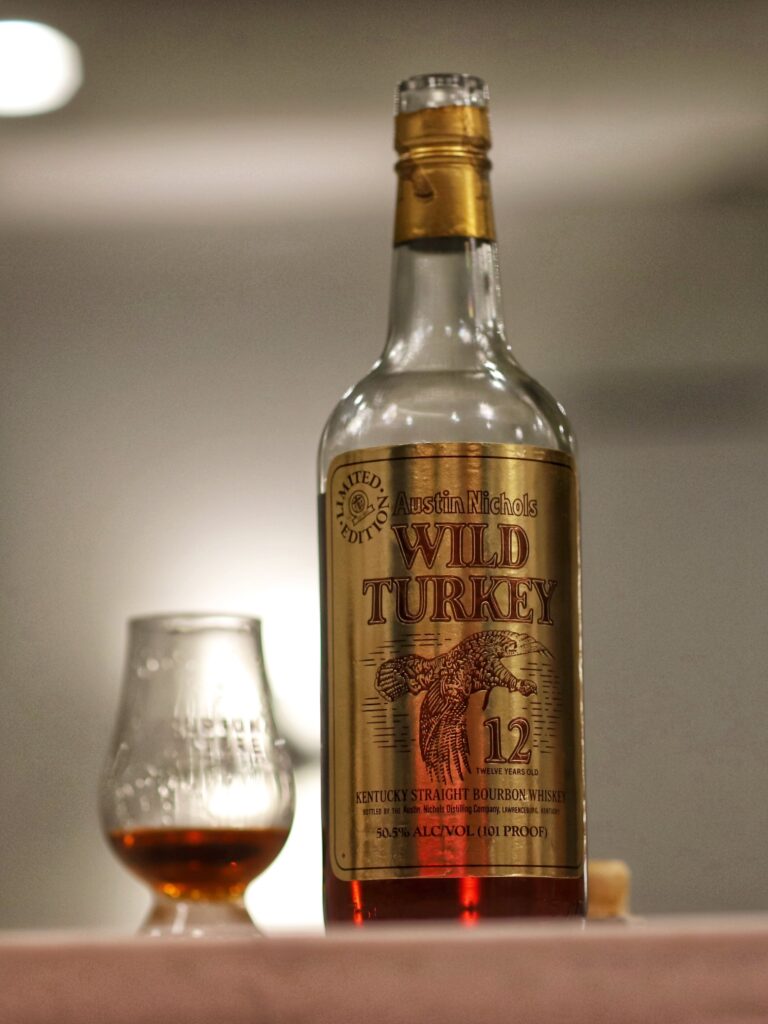
Around 1985, Austin Nichols (Wild Turkey’s owners at the time) recognized a growing fad of bourbon drinkers in Asia – Japan to be specific – and decided to take advantage of it. They exported their “Beyond Duplication” bottles to Japan while switching the label design for the same product in the United States. In that way, you’ll still find the first generation of Beyond Duplication bottles being sold in Asia as late as 1992 while domestic drinker’s would find their bottles wearing a new, garish gold foil label starting in 1985. Enthusiasts would dub this example “Cheesy Gold Foil.” Here’s a graph I used in my previous review so you can visually see how it all breaks down:


Because the domestic appetite still wasn’t as voracious for bourbon, Wild Turkey actually paused production on this cheesy gold label for two years – 1986 and 1987 – before resuming again in 1988. The company continued to label it this way until 1993 when the label was changed to the “Split Label” design. Strangely, Austin Nichols allowed an export version of CGF for two years – 1993 and 1994 – until changing it to the Split Label design as well. I should note that last fact is debatable amongst some circles as enthusiasts have found export bottles of CGF with a “90” stamp on the bottom of the glass. Many explain it away by saying that Wild Turkey was just using old stockpiles of glass.
The Old Boone/Cheesy Gold Foil controversy
Did you know that Wild Turkey just a brand and not a true distillery up until 1972? It’s true. It was only then that the Austin Nichols company purchased what used to be the JTS Brown Distillery in Lawrenceburg, KY so they could call that product their own. Austin Nichols still had many barrels of sourced bourbon in their inventory after the purchase so they were slowly blended into the tanks that held 8/101 or their new 12/101 label they had just created in 1982. Now here’s where collectors and high-end enthusiasts really start to focus on – bourbon distilled by the Old Boone distillery. Old Boone was officially kaput in 1979, but not before selling lots of bourbon they had made for others. Wild Turkey was one of their customers.


Just because 1980 was the first year they could bottle their own bourbon didn’t mean they stopped using the sourced barrels they had acquired. Those barrels cost money, after all, so they were slowly blended into the tanks that held 8/101 or their new 12/101 label they had just created in 1982. Now here’s where collectors and high-end enthusiasts really start to focus on – bourbon distilled by the Old Boone distillery. Old Boone was officially kaput in 1979, but not before selling lots of bourbon they had made for others. Wild Turkey was one of their customers.
So many distilleries were going out of business around that time period that it seems weird that we’d care about one distillery that sold Wild Turkey some barrels, right? After all, if it was blended in with other barrels, how would we know what it tastes like? The answer lies almost 10 years into the future from when the first Cheesy Gold Foil bottle was released. It turned out that Julian Van Winkle, who set up shop at the Old Hoffman Distillery across town from Wild Turkey, had purchased 400 or so barrels of Old Boone from Wild Turkey. He used many of those barrels to make the first release of Pappy Van Winkle 20 Year in 1994. That’s the bourbon that put him and his brand on the map after it scored a 99 (out of 100) at the Beverage Tasting Institute’s World’s Spirit Competition. Oh, and if you didn’t already know it, the type of bourbon that Old Boone distilled was actually a high-rye recipe proving that not every bottle of Pappy Van Winkle has had wheated bourbon in it.
With enthusiasts so clearly enamored with the lore of these Old Boone barrels, many started to do the backwards math and came to the conclusion that Wild Turkey would have been using (blending) Old Boone barrels in everything from 1970’s-era Wild Turkey 8/101 to Beyond Duplication 12/101 bottles from 1982 up until 1988 (when they began to sell Julian Van Winkle III their remaining Old Boone barrels). I should also point out that there have been many people who have asked Jimmy Russell to verify if early CGF bottles contain Old Boone in it and the answer is always muddled. There should be no doubt that Old Boone was blended into some Wild Turkey somewhere along the line, but no records really exist to verify this. However, because this belief persists is why CGF bottles from 1985 and 1988 always fetch a premium over CGF bottles from 1989 to 1993.


The bottle I’m reviewing today is from 1990 (at least, that’s what the glass number says on the bottom of the glass) and was shared to me graciously by my good friend Mike over at Mostly Peaceful Bourbon. While it likely doesn’t contain Old Boone in it, there’s no doubt that there are several barrels containing bourbon much older than 12 years in it. So how is this dusty pour? Let’s find out. I sampled it neat in a glencairn.
Tasting Notes
Nose: Yup, the nose on this instantly tells me that what I’m about ready to taste is way older than 12-years-old. The amount of rich oak, musty wood furniture and fine tobacco leaf notes are supremely dense. They don’t come across as too strong, maybe because of the amount of sweet scents behind it. I’m talking a vanilla frosting, butterscotch candies and fudge. All fruit notes feel like they’ve been concentrated and condensed – with cherries and a bit of fruitcake. I think the chocolate on this one is less than the 1988 Beyond Duplication I recently reviewed, while the spice level is a little more noticeable. This is a trend I’ll continue to see in the rest of these notes.
Palate: This bourbon is some of the richest-tasting bourbon at this proof point I’ve tasted. The mouthfeel is heavy and dense with an oily coating that won’t quit. The tannins are putting in a full day’s work with musty oak, cigar box and oily leather. The sweet, oxidized cherries and the heavy brown sugar/caramel notes keep any bitterness at bay. I can also taste a version of vanilla that is much more robust than a standard vanilla icing or vanilla cake. I don’t know how else to describe it except to say that it doesn’t evoke the same lightness as it would in a baked good. Another fun flavor find is butterscotch – not too much – but just enough to make me sit up and take notice since it’s a rare bourbon note and one that is usually found in top-tier bourbons (or maybe butterscotch instantly makes a bourbon top tier?). Rye spices also add a bit of anise, cinnamon and pepper. Just enough to tingle the tongue and make it more exciting (in a way) than the 1988 BD I just had.
Finish: If a musty, sweet oak bomb had just exploded on my tongue, this would be what the fallout tastes like. Once again, it comes close to making me think it was going to turn too tannic and bitter, but there are enough brown sugar/butterscotch notes and vanilla to squelch any fear of that. Oxidized cherry juice and some anise mixed with toasted citrus peel helps add nuance after the sip is complete. The finish is incredibly long and I’m savoring every moment of it.
Score: 9.5/10
This Cheesy Gold Foil does not disappoint. But why would I have thought it would disappoint anyway? These have consistently been some of the best “Dusty” bottles every produced. And just because this bottle isn’t from 1985 or 1988 doesn’t mean that it’s not spectacular in its own right. There’s a little less chocolate and a little more spice compared to pre-89 bottles, but if you are able to taste any of these examples, you should still count yourself lucky. This is simply the pinnacle of bourbon.

Final Thoughts
It’s 2025 and we’re just starting to enter the Bruce Russell era of Wild Turkey. He’s been training for years to step into the shoes of giants and has left his mark on products like Generations and Beacon (to name a few). He’s even the sole Russell to have his name on the near-future release of Wild Turkey Austin Nichols Archives “Gold Foil Edition.” I’m excited for this new chapter in Turkey lore, but I’m here to tell you right now that while he may be saying and doing all the right things in the eyes of enthusiasts, he’s not going to be able to recreate the magic that was in these old bottles. I wish him the best of luck in trying to get close, but Wild Turkey would have to systematically change all of their processes to get their products back to the way they were in order to achieve something close to the magic that was in Cheesy Gold Foil. And as long as Campari pulls the strings, that ain’t happening.
Instead, track down a bottle or a pour to savor for yourself and compare it to modern-day Wild Turkey. I’m not saying the recent stuff is bad, it’s just different from the past. So sip and savor this if you can and enjoy a glimpse of the past. We can’t always bring the past back to life, but the memories we have of it are best shared with friends and a great glass of bourbon.