


*Bourbon Culture is reader-supported. When you buy through links on our site, we may earn an affiliate commission.
| Don't like ads? | No ads |
Unless you’re from Pennsylvania or Maryland, rye whiskey has always played second fiddle to bourbon in the United States. Even today, its sales numbers are dwarfed when compared to its corny brother. That’s a shame when it comes to a brand like Michter’s who has a lot of clout for producing some of the best rye whiskey around.
A 14-sentence history of Michter’s rye whiskey
Michter’s origin story with rye whiskey dates all the way back to 1753 when the “distillery” (which was more like a moonshine operation based on a farm) was originally started by the Shenk’s. The distillery grew larger over the years leading up to a more modern facility being opened shortly after World War II. That’s when they added a modern column still with a doubler and increased warehouse capacity.


While Michter’s (which is what the distillery was named sometime after Prohibition was over) undoubtedly produced rye whiskey for other customers (early Wild Turkey Rye is said to be from here), they concentrated on creating a “sour mash whiskey” for their own commercial use. The reason why it was not called a bourbon or a rye whiskey was because the recipe did not have 51% of any particular grain (it was 50corn/38rye/12malt).
Still, rye whiskey was considered part of the brand’s heritage by time Joe Magliocco bought the trademark rights in 1996. Originally he started off being more interested in buying barrels of bourbon, but Julian Van Winkle III – who was contract-bottling Michter’s at the time – claimed to sell him around seven “batches” of rye whiskey from 1999 to 2002. These would be put into the first bottles of Michter’s 10 Year Rye Whiskey – which is identifiable because of the words “Small Batch” on the label. To this day, it’s the only rye whiskey product from Michter’s that was not a single barrel.


Michter’s utilization of JVWIII’s bottling services was short-lived as Sazerac had given him an offer he couldn’t refuse. Thankfully, Julian introduced Joe to Even Kulsveen of Kentucky Bourbon Distillers (KBD aka Willett) who was known to sell barrels and bottle for other proprietors. During this time, Even sold Joe barrels of bourbon and rye whiskey from his very mature stocks even after Joe signed a contract with Brown-Forman to distill whiskey to his specifications.
Both of these relationships lasted until about 2011/12 when Even had to cut Michter’s off because they were finishing up with the construction of their own distillery and Brown-Forman was ramping up their own production because the “boom” was in full swing. I’ll get to why all of this matters in a minute.
Michter’s 25 Year Old Rye Whiskey
During Michter’s time of sourcing from and being bottled at KBD, an idea for an even more premium whiskey lineup was hatched. For almost a decade, Michter’s had enjoyed some notoriety for their 10-year products – mostly due to the fact it was never just 10-years-old. Joe had initially sourced barrels ranging from 16 to 19-years old. As some of those barrels reached the two decade mark, it made little sense to continue putting them into a product wearing an age statement that was half that. Michter’s 25 was born.

At about the same time in 2008, Michter’s applied for 25-year-old labels to the TTB. You can see what the original version of M25 Rye looked like here. Check out Even Kulsveen’s name and DSP number on the form for more proof. But what comes next is still being debated today: when did the first bottle of Michter’s 25 Rye hit the shelves? There was a post on straightbourbon.com in late 2009 about the existence of M25 Rye. But that’s just talking about it and nobody in that chat claimed to see one at that point. People could even argue that this auction claims the existence of a 2008 bottle, but I remain skeptical.
I tracked down all pictures of M25 Rye bottles I could find. After recording them, I have concluded that there might be only 8 barrels ever produced. They are:
Barrel No. 86 – 150 bottles (Bottled in Bardstown)
Barrel No. 102 – 158 bottles (Bottled in Bardstown)
Barrel No. 1232 – 46 bottles (Bottled in Bardstown)
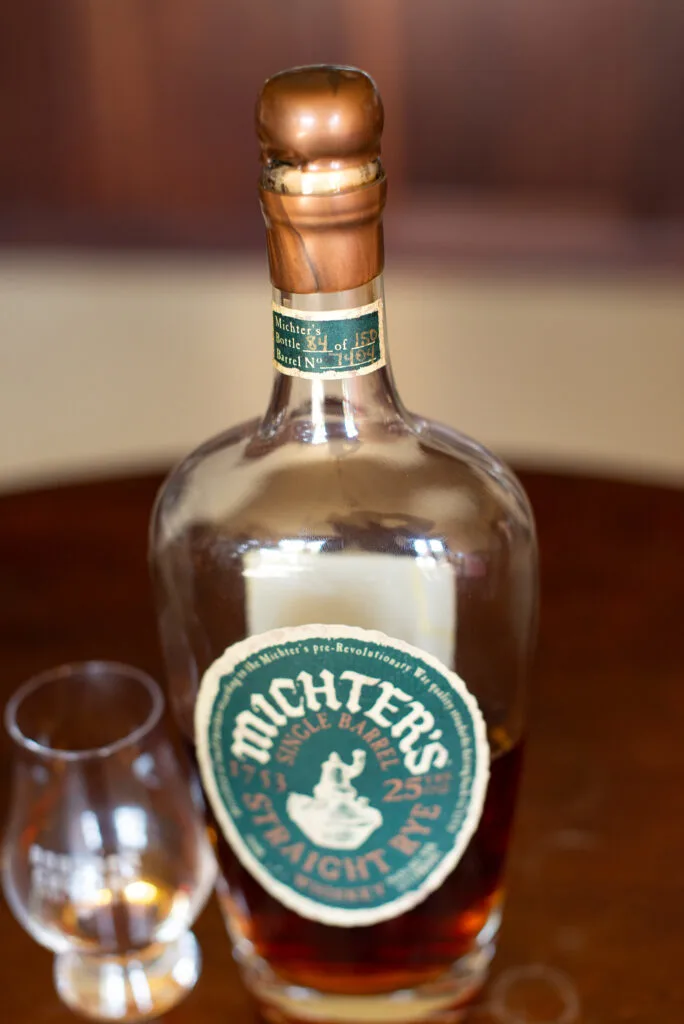
Barrel No. 7404 – 150 bottles (Bottled in Bardstown)
Barrel No. 13H214 – 158 bottles (Bottled in Louisville)
Barrel No. 13G119 – 44 bottles (Bottled in Louisville)
Barrel No. 14L719 – 106 bottles (Bottled in Louisville)
Barrel No. L14D201 – 25 bottles (Bottled in Louisville, the “L” is for export)
Right off the bat, we know when the last four were bottled – 2013 and 2014. And if you’re a big Michter’s nerd, you’d know that Barrel No. 1232 and 7404 were bottled in 2012 because for some reason Michter’s used four digit codes for all of their Single Barrels that year – bourbon and rye. And before you ask, I don’t know why they did this, haha. That leaves Barrel No. 86 and 102 as the outliers. Dating them becomes hard because social media wasn’t as prevelant as it was today. At the time of writing, I can say while I haven’t found anything conclusive, the only two options seem to be M25 Rye was either released in 2008 or 2011. My gut (and this piece by Bourbonr) tells me it was the latter.


Whichever way you slice it, that’s not a lot of bottles – 837 total by my count. Whiskey Advocate claims 1,050 bottles were released (and all in 2012?) but I don’t know where they got their numbers from. If you know of another barrel(s) that exits, please let me know. And if you own one of these bottles, you probably already know you’re in extremely rare company.
Source of M25 Rye
That previous statement brings me to my final point. Is the rarity of this rye whiskey that big of a deal? I’ve already demonstrated that simply owning a bottle with this label is a big deal, but what about the liquid inside? That’s where I will confidently proclaim that all of my research points to the rye whiskey being made at the New Bernheim distillery back when it was owned by United Distillers. It is also known by another name – “Cream of Kentucky” (CoK) Rye. If you’re wondering where you’ve heard that before, I did a big write up of its story in a recent Sazerac 18 review a couple years ago that’s worth a read.
The only point I’m not sure of is what time period Michter’s obtained these rye whiskey barrels. I was under the impression that they bought it from KBD, but there’s a real possibility that these were the original lot of rye whiskey barrels Joe purchased directly from United Distillers (which JVWIII commented on in the link I posed above). If that’s the case, he just held onto them until they hit this wild age. Either way, the source is likely the same, but the year they were distilled and the location they were matured might vary. This goes a long way in explaining why the secondary price for a bottle of M25 Rye is right up there with a lot of the most desirable KBD ryes like Iron Fist, Velvet Glove and LeNell’s Red Hook Rye.
I appreciate if you’ve read this far and I hope you learned a lot. But now let’s get to the part that you’ve been patiently waiting for – the tasting notes. The bottle you see before you is from Barrel No. 7404 and was purchased by my friend Carl from the Neat Drinkers Association in California. He also took the pictures which I think turned out amazing, thanks Carl! He commented that he purchased it in 2012 which lines up with the timeline I’ve established so far. So how is it? Let’s find out. I sampled this neat in a glencairn.
Tasting Notes
Nose: A small prickle of spices flows upwards and out of my glass followed closely with the sweet notes of Grandma’s (hard) candy dish and salted caramel. Those sweet fruity notes with the odd spices (nutmeg, allspice and a bit of anise),smell like they came from a Christmas fruitcake. There are also lots of floral notes along with savory herbal scents. The “pecan shells” note isn’t necessarily me saying that this rye whiskey had a nutty aspect to it, it was more like the woody, earthy outside portion of a nut. Speaking of “woody,” the barrel influence is not as tannic and overwhelming as you might think for 25 years in oak. It’s more like a soft blanket covering it all. Part of me feels like the wood doesn’t even smell like it’s been charred if that makes any sense. I blame it on all of the oxidation that’s likely occurred – and maybe also their filtering process.
Palate: A remarkably easy drinking, laid-back affair with lots of floral flavors (wildflowers, mums, eucalyptus) that pair well with herbal flavors (not mint, but a kind of licorice) and a sort of muted rock candy sweetness to boot. There are soft spice notes that make you admire how unique they are with nutmeg, anise and oak spice flavors all around. One of the stranger flavors I’m finding on both the palate and finish is a bit of “banana bread.” No, this isn’t like a Jack Daniel’s product, the I can tell it tastes like a very bready/starchy fruit and hints towards the flavor of a banana.
As for tannins, there are lots of antiqued wood, shoe polish on leather and a hint of cigar ash. Some heat (if you can call it that) seems to come from finely ground peppercorn, Fruit flavors abound with the most interesting being watermelon rind. I also taste citrus zest/pith. Baked good flavors include gingersnap cookies and poppyseed muffins. And just when you thought this laundry list of flavors couldn’t get any longer, I also pick up on the tiniest hint of flint. My hands are officially tired of typing.
Finish: I’m finding the strangest sensation of all the peppery flavors disappearing into a void as soon as I swallow. What remains is fruit, oak, floral notes and some baked goods. The banana nut bread continues to impress and confuse me while light flavors of cherries and breadfruit stay put, too. The oak reveals itself more, but rather than making everything feel overly tannic, it acts as more of a presence to soften the residual flavors. Gingerbread and poppyseeds also bring up the rear in a surprisingly complex finish.
Score: 10/10
This is one of the most interesting and memorable dusty rye whiskies I’ve tasted and I’m sure it has everything to do with its age. I have never had one of those fantastic dusty Willett’s or many of the offshoots that proclaim to use the same juice, but if this is what they taste like, there’s no equal – well, maybe the Medley rye whiskey that JVWIII used for a period of time, but that’s a story for another day.


Had this been proofed down to something under 100, I don’t think it would have achieved a perfect rating. But allowing it to be bottled at 117+ proof points ensured that every scent and flavor was front and center. It was like they waited in line for your tongue to acknowledge them before proceeding onto the next one. The balance – especially with the oak in play – was masterful as well. I’ll be thinking about this rye whiskey for a long time.
Final Thoughts
From some accounts, the Medley rye that JVWIII bottled a little bit before this is a superior rye whiskey to this bottle. I’m only bringing that up because inevitably there will be people who will tell me stories of how they’ve had a better rye. I’m not so oblivious to the fact that there are probably slightly better rye whiskies compared to what’s in here – after all, I haven’t tried everything – but my point in awarding another perfect rating is that there’s simply no equal at the moment. There are also no flaws. It’s simply in a class by itself that has changed my worldview on what a rye whiskey can be. I have a lot of love for ryes, but I may just love this one most of all.