


| Don't like ads? | No ads |
When Bomberger’s Precision Fine Grain (PFG) Bourbon arrived in the early Spring of 2025, I brushed off my urge to run out and find one immediately – let alone pay secondary prices for it. But when no bottles came anywhere near the Indianapolis area and when friends of mine couldn’t even obtain one without a ridiculous markup, I began to panic. Surely it was not such a limited release that I missed out, right?
Well that turned out to be mostly true. While Indiana didn’t get their official allotment until the middle of the Fall, even those bottles quickly disappeared off shelves. The secondary market also never budged with prices remaining stuck at around $425. Let me remind you that this was supposed to be a $140 bottle at retail. When a perfect storm like that comes together, it usually means they either didn’t make a lot of it or the whiskey is so good that enthusiasts have begun to horde it.
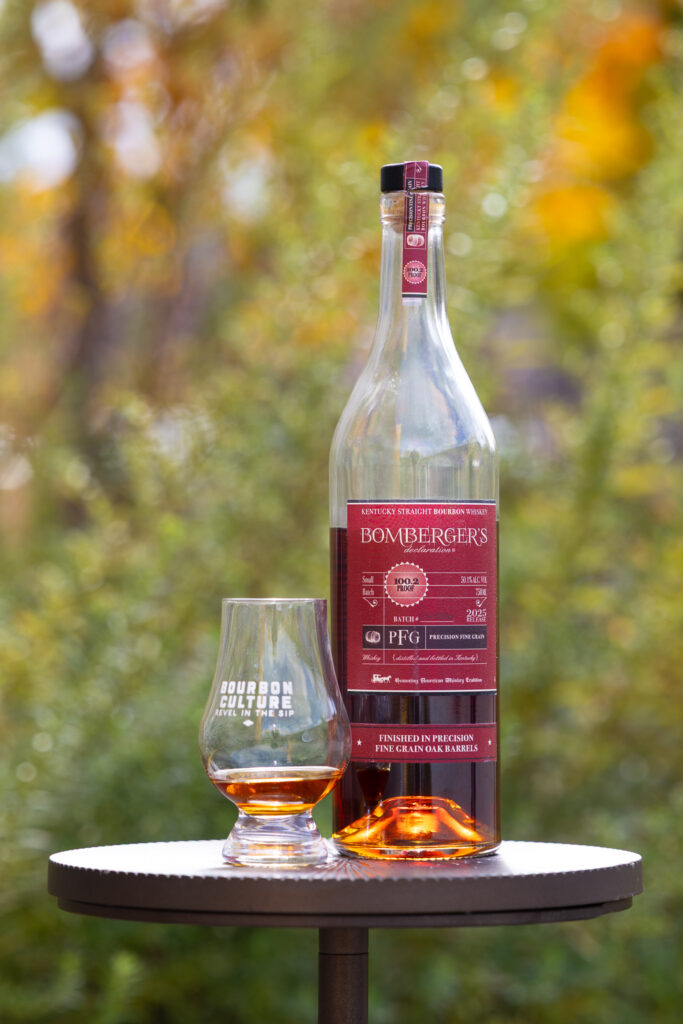
Bomberger’s Precision Fine Grain Bourbon
It took me until just recently to finally get a chance to review one. In a way I’m glad I had to wait this whole time because I would have started this review speculating that Bomberger’s PFG was replacing the standard Bomberger’s Declaration release. That ended up not being the case because the standard bottle came out just a couple months ago.
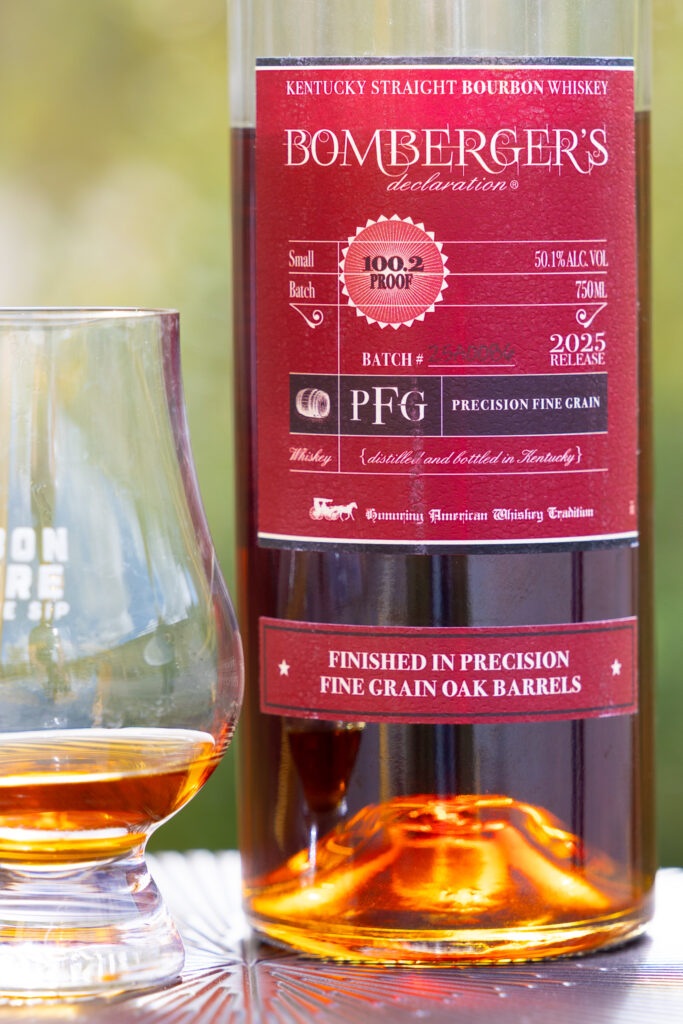

So what place does PFG have in the Michter’s lineup? That’s a good question because this release kind of came out of nowhere. Michter’s doesn’t necessarily have an experimental line in their portfolio so they have tapped Bomberger’s to be it. I would’ve thought they’d choose Shenk’s, personally.
Standard Bomberger’s has traditionally included a portion of the final bourbon blend to be finished in Chinquapin Oak barrels. In the past, I’ve estimated as high as 50-75% of the blend contained bourbon finished in those barrels. PFG is not so different in that regard. It reads like it has swapped the Chinquapin out for French Oak. And if you’ve ever had anything finished (or aged) in Chinquapin Oak, you already know it’s kind of like America’s version of French Oak.
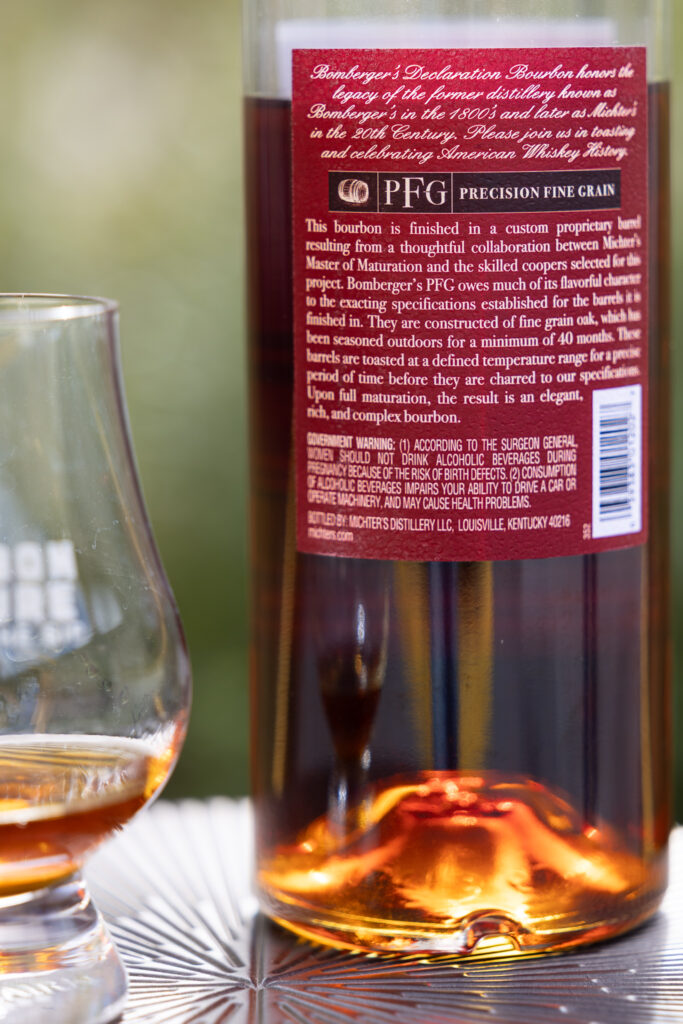

Wait a minute, you know what else uses a French Oak finish? Shenk’s. That’s right, in the past I’ve covered that Shenk’s is a blend of rye whiskey and bourbon (so technically, a bourye). The bourbon component has occasionally received finishing treatment in French Oak barrels, too. So was Bomberger’s PFG really just Michter’s way of taking something old (a component of Shenks) and turning it into something new? The reality might not be that far off.
Are some oak trees more valuable than others?
I suppose I should talk about the French Oak for a minute because that’s what Michter’s wants us to draw our attention to. According to them:
“The Bomberger’s PFG finishing barrel is a blend of wood from various origins, including the revered Troncais, Allier, Nevers, and Vosges forests. It is constructed from wood that has been naturally air dried outdoors for a minimum of 40 months in France near the Charente River, which has a unique seasoning environment influenced by humidity, microflora creation, climate, wind direction, and elevation. After this seasoning, the staves are hand selected to construct the Bomberger’s PFG finishing barrels.”
While that all sounds super fancy, I have one question: what makes the French Oak used in these Michter’s barrels different from other producers’ French Oak finished offerings? I think the answer is as simple as how much information a producer is willing to put into their press release. Michter’s did their homework on where their barrels were sourced from and which forests the cooperage sourced their wood from. Bardstown Bourbon Company also did this with their Cathedral Oak release this year. I’m not saying Michter’s – or any producer for that matter- shouldn’t take pride in their barrels, I’m just saying there’s a good chance we’ll see more producers start to include specs on which forests their French wood comes from and how long their staves have been air-dried for. If that happens, we might see that other producers are using barrels that sound just as good.


What’s interesting with this release is how low the proof is. To be fair, Bomberger’s has never been labeled as barrel strength (unlike Michter’s limited edition barrel strength bourbon and rye whiskey has been), but at 108 proof, it always felt close to it. Bomberger’s PFG rings in at 100.2 proof which feels arbitrary. I wish they would’ve expanded more on the press release to tell us if this proof was chosen because the oak was simply too powerful at barrel strength or if they lowered the proof of the bourbon before adding it into the finishing barrels (which is something that Brown-Forman is known to do with Woodford Double Oaked and Old Forester 1910).
Before I get to the tasting notes, I want to add my standard spiel of what Michter’s bourbon is: they utilize the Early Times bourbon mash bill (79/11/10) coupled with a similar yeast strain and a low barrel entry proof of 103. Their standard barrels use staves that were air-dried for 18 months and are toasted prior to receiving a char (which varies, btw). Just wanted to throw that in here before I moved on. I sampled this neat in a glencairn.
Tasting Notes
Nose: Wow, I haven’t smelled a bourbon where the oak was so closely joined to the cherry scents. There are also loads of French Mendiants which combine chocolate, nuts, sweets and dried fruits. A hidden scent of toasted marshmallow hides behind the rest. I can also pick up on a touch of toasted orange peel.
Palate: The oak spice and stewed, spiced cherries have such an intensity that I can’t think of an equal off the top of my head. Chocolate and cinnamon come in waves. I think I’m even detecting some wet tobacco throughout. I can’t believe what I’m tasting is not barrel proof – each sip is so robust. The oak is so varied it’s like I can taste that there are different varieties in here. I don’t know how to describe “different oaks” but sometimes the oak tastes charred, sometimes it tastes like it has a spice note in it like a bit of allspice or clove and sometimes it tastes very old – like a great barrel of M10 would taste.
Finish: While oak coats my tongue and stays there long after the sip was done, it never turns bitter. The dried fruit is primarily comprised of cherries even though I can taste a bit of apricots and citrus rind. There’s enough sweetness and chocolate that it continues to stay interesting. This might be one of the most impactful ~100 proof bourbons I’ve drank. The finish lasts for a very long time.
Score: 8.7/10
It doesn’t take much for me to fall in love with a new Bomberger’s release, but this one is special. I was originally skeptical about the missing 8 proof points and the flowery language of the French Oak barrels. One sip was all it took to erase all doubt from my mind. No wonder this bottle hasn’t dipped in price on the secondary market, it’s worth every penny. It’s an amazing sip that just won’t quit.

Final Thoughts
My final thoughts section is usually when I wrap up my feelings about the current bottle I’m reviewing, but this is the one rare time where I talk about the future of this series. I feel as if this is the direction that Bomberger’s should go – at least as far as changing up the formula to make something different. No more adding malted rye to the mash bill, Michter’s, this is what the people want!
I’ve been inside of Michter’s Shively distillery and walked through their warehouse and can say that this isn’t the only experiment we’ll see. There are lots more in store that I’m also eagerly awaiting. But PFG takes the cake for now. It’s superbly balanced, has tons of unique oak flavors and shows you that experimentation is still alive and well inside of Michter’s walls. Try to find a bottle or pour right now, you can thank me later.