

| Don't like ads? | No ads |
Bourbon age statements generally reflect the youngest whiskey in the bottle; not the oldest component or the average age. A 7 year bourbon can contain 15 year whiskey. Without the proportions, you cannot tell how much older whiskey is inside.
That sounds straightforward until you’re holding a bottle that says 7 years on the front and lists 15 year bourbon on the back.
Your eyes will probably land on 15. Mine would, too. It’s the number that makes you pause, turn the bottle around again and start doing the mental math on its price.
But before you give that older component too much credit, there’s another question to ask:
How much of it is actually in there?
Three Barrell releases from our review archive show why that question matters. Each discloses something useful about its blend and leaves something else unanswered.
Here, “blend” means bourbon assembled from multiple barrels, ages or sources. We’re also including finished bourbon examples.
How do bourbon age statements work in a blend?
For whiskey containing no neutral spirits, TTB explains that age can be stated as the age of the youngest whiskey, or through a statement listing component ages and their percentages. A single age statement does not represent an average of the barrels involved. TTB’s distilled spirits guidance
When you encounter several ages in a product description, first establish what each number describes.
| Information on the bottle | What it establishes | What remains unknown |
|---|---|---|
| A single 7 year age statement | The youngest whiskey’s stated age | The oldest component and average age |
| A disclosed 7 to 15 year range | The reported span of component ages | The proportions of those ages |
| Component ages listed by state | Which disclosed ages correspond to which states | Their proportions and, potentially, the distilleries |
| Component ages with percentages | The disclosed age composition | How the finished blend will taste to you |
More information helps. It doesn’t make every unanswered question disappear.
7 years on the front. 15 on the back.


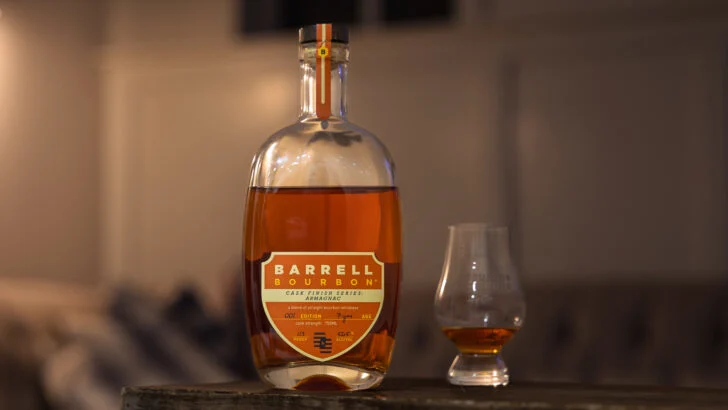
Barrell’s Cask Finish Series Armagnac is a good bottle to turn around.
The bottle photographed in our review carries a 7 year age on its front label. Its rear label lists a much wider selection:
- Kentucky: 10 year bourbon.
- Indiana: 7, 8, 11 and 12 year bourbon.
- Tennessee: 9, 13, 14 and 15 year bourbon.
There’s no contradiction. 7 years describes the youngest component; 15 years describes one of the older components.
But that does not make the whole release a 15 year bourbon. Nor does the list tell us whether the 15 year component represents a substantial share or a small addition. See our Barrell Armagnac review
That’s the first useful distinction: an older component’s presence and its proportion are different pieces of information.
What bourbon age statements leave out about proportions
Imagine two blends made from 7 and 15 year bourbon.
One uses mostly 7 year whiskey with a small addition of 15 year. The other reverses those proportions.
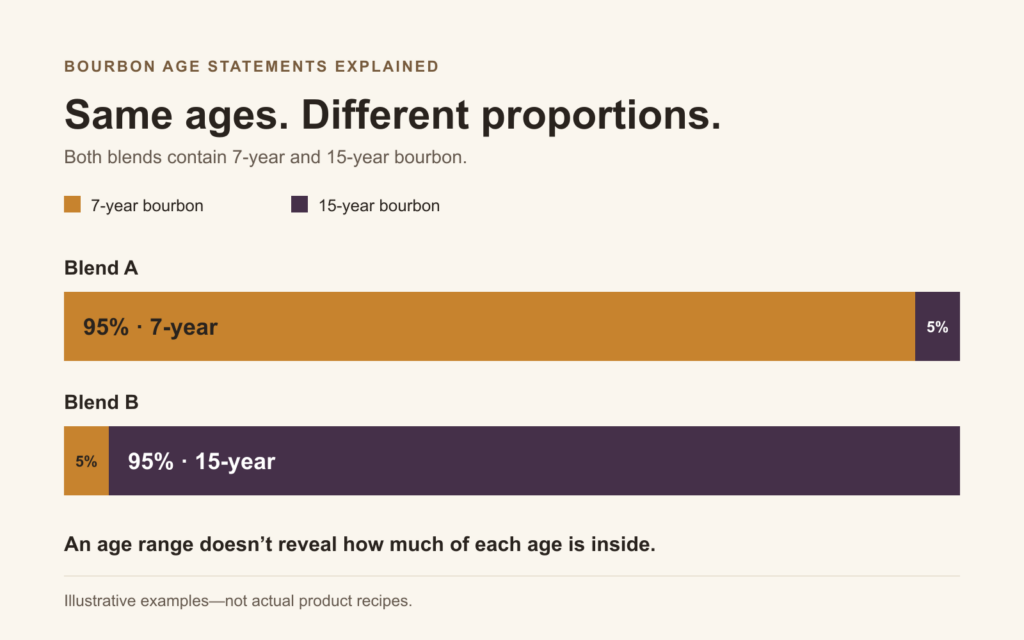
The example recipes
| Hypothetical blend | Seven-year bourbon | Fifteen-year bourbon |
|---|---|---|
| Blend A | 95% | 5% |
| Blend B | 5% | 95% |
Illustrative examples—not actual product recipes.
Both contain the same two ages. Both have 7 year whiskey as their youngest component. Yet the recipes are dramatically different.
Even their calculated average ages differ: 7.4 years for Blend A and 14.6 years for Blend B, using the stated proportions. Those averages are arithmetic descriptions of these hypothetical recipes; not replacement age statements or predictions of quality.
This is why taking the midpoint of an age range can mislead you. The midpoint between 7 and 15 is 11, but that assumes equal quantities of those two ages. A producer may never have claimed anything close to that recipe.
And a real blend might contain several ages between its youngest and oldest components.
An age range gives you endpoints. It does not give you the recipe.
Does a detailed component list solve the problem?


It solves part of it.
Barrell Bourbon Batch 036 discloses 9-year Kentucky bourbon; 7.5, 8 and 10 year Indiana bourbon; and 8 and 15 year Tennessee bourbon.
That is useful detail. We can connect an age to a state rather than treating the entire blend as one undifferentiated range.
What we cannot do is assume equal portions. Six listed components do not mean each accounts for 1/6th of the bottle. Counting how many ages come from a state also does not establish that state’s share of the blend.
And knowing a state does not automatically identify the distillery. That requires separate evidence. Read our Barrell Bourbon Batch 036 review
For the buyer, the distinction is simple: appreciate the disclosure, but don’t finish writing the recipe yourself.
Finishing adds another question age cannot answer
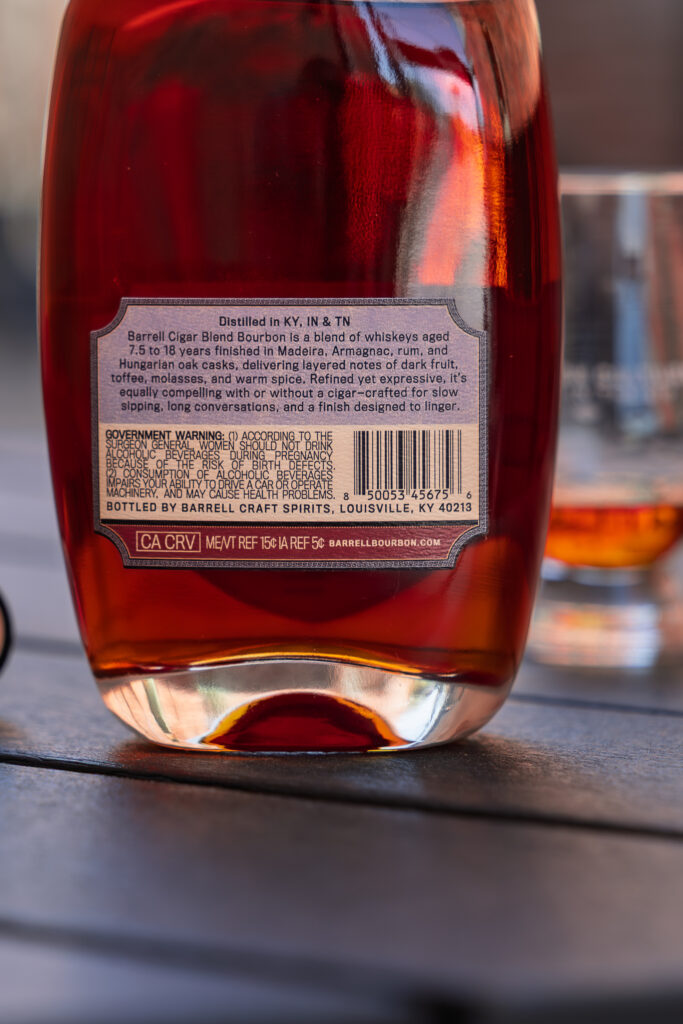
The rear label on the Barrell Cigar Blend bottle photographed in our review describes whiskey aged 7 and a half to 18 years.
18 is an attention-getting number. The label does not tell us its proportion.
This release also uses Madeira, Armagnac, rum and Hungarian oak finishing casks. Those details matter when interpreting its character. How much of what you taste comes from the underlying bourbon, and how much comes from the finishing treatment?
The age range cannot settle that question. It also does not tell you how long the finishing treatments lasted. See our Barrell Cigar Blend review
A component age and a finishing duration answer different questions. If one is disclosed and the other isn’t, leave the missing information missing.
Can you taste the oldest bourbon in a blend?
You can describe what you taste. Assigning that flavor to a particular component takes more evidence.
Leather, tobacco and heavy oak might lead a reviewer to describe a whiskey as mature. Those impressions do not prove that the oldest component dominates the blend or establish the age of an undisclosed barrel.
The reverse matters, too. Bright fruit or a lighter profile does not tell you that older whiskey is absent.
Without tasting the components separately or having reliable information about their contributions, “that must be the 15 year bourbon” remains an interpretation.
That doesn’t make tasting notes less useful. It keeps sensory observations in their proper place.
How to use bourbon age statements when buying a bottle?
Age deserves your attention. It should share that attention with the rest of the bottle.
A younger statement does not tell you whether a blend will disappoint you. An older component does not guarantee you’ll enjoy it. Neither tells you whether the asking price makes sense for your preferences.
Before paying more because a description highlights older bourbon, ask:
- Does that age describe the whole bottle’s youngest whiskey or just one component?
- Is the older component’s percentage disclosed?
- Am I judging the documented recipe, or imagining a more generous one?
- Does the review describe flavors I actually enjoy?
You can still decide a bottle is worth buying when its proportions are undisclosed. Just recognize what you’re paying for: the finished blend, its documented details and your expectations; not an assumed quantity of its oldest whiskey.
The next time a 7 year bottle mentions 15 year bourbon, turn it around and read closely. The older whiskey is worth noticing.
The missing percentage is worth noticing, too.
Erich
Tuesday 13th of October 2026
Great article & basically is the exact reason I went to DSP-only bourbon whiskey a few years ago & vowed Not to buy any more “blends” from NDPs. They’re nothing more than mixologists.
There’s 0.0 appeal for me…to drink something from who knows where… as opposed to buying something that I know was created by a “real” distiller, who’s been doing this more than 10 minutes. The Fab 5!!! BF, BT, JB, HH, WT Ok & a couple more. 4R, AE Am I missing out on a very small # of good bourbons - probably…but not that many from what I read.